

Digital marketing has changed how businesses promote their products and services, connect with customers, and build their brands. Instead of depending entirely on traditional advertising methods such as television commercials, newspapers, and billboards, companies can use websites, search engines, social media, email, and other online channels to reach potential customers.
One of the biggest advantages of digital marketing is its flexibility. Businesses can select different marketing channels according to their goals, target audiences, and available budgets. For example, a small business can use search engine optimization (SEO) to attract organic website visitors, social media to build brand awareness, and email marketing to maintain relationships with existing customers.
Digital marketing is not limited to large companies with substantial advertising budgets. Startups, freelancers, local businesses, and established organizations can all use online marketing strategies to reach relevant audiences and grow their businesses.
Understanding the different types of digital marketing and their advantages can help business owners make informed decisions about where to invest their time and resources.
Table of Contents
Digital Marketing and Its Role in Modern Business
Consumers increasingly use the internet to discover products, compare services, read reviews, and make purchasing decisions. As a result, having an online presence has become important for businesses that want to remain visible and competitive.
Digital marketing helps companies connect with potential customers through the online platforms they already use. A business can attract visitors through search engines, introduce its products through social media, share useful information through blog posts, or reach interested customers through targeted advertisements.
Another important characteristic of digital marketing is that its performance can be measured. Businesses can monitor website traffic, advertising clicks, customer engagement, and conversions to understand which activities are producing useful results.
The digital marketing landscape also continues to change as consumer preferences and technologies evolve. Keeping up with the latest digital marketing trends can help businesses identify new opportunities and adapt their marketing strategies.
Different Channels and Strategies Used in Digital Marketing
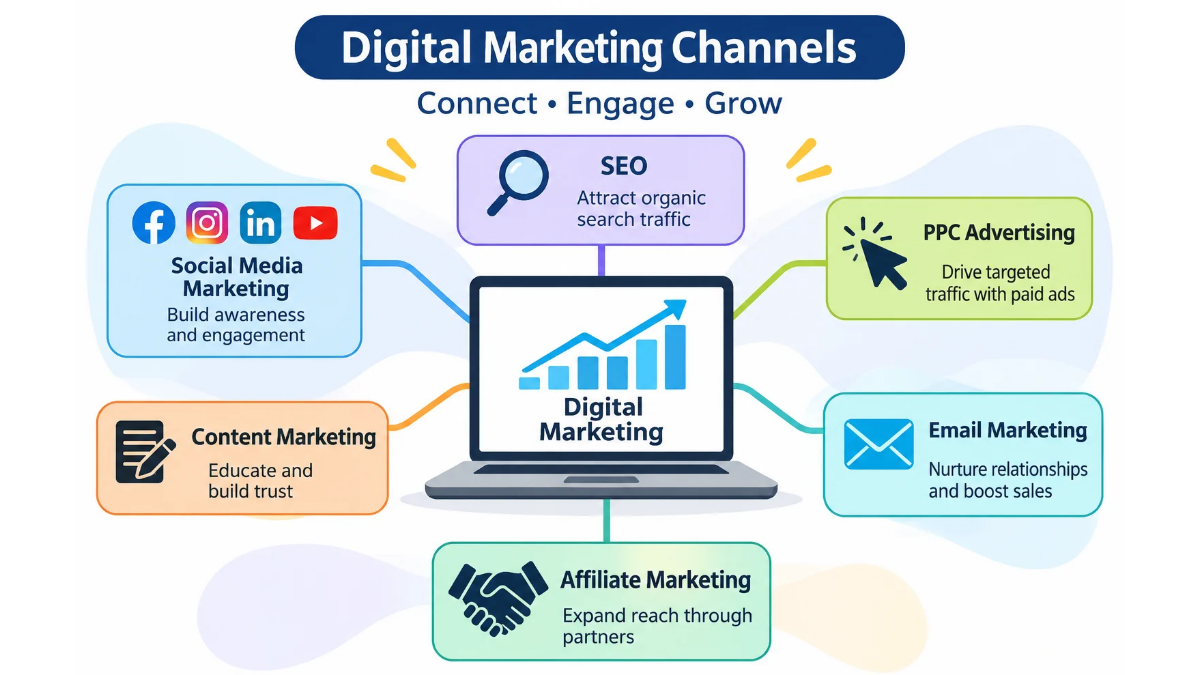
Digital marketing is not a single advertising method. It includes several channels and strategies that businesses can use independently or combine to achieve different objectives.
Some channels focus on attracting website visitors, while others help businesses communicate with customers, promote products, or generate sales.
Here are some of the most widely used digital marketing channels.
1. Search Engine Optimization (SEO)
Search engine optimization (SEO) is the process of improving a website’s visibility in organic search engine results. It involves optimizing website content, researching relevant keywords, improving technical performance, organizing website structure, and earning relevant backlinks.
For example, a company selling home appliances can optimize its website pages to appear when people search for information about refrigerators, washing machines, or other related products.
SEO can help businesses attract visitors who are already interested in their products or services. Unlike paid advertising, businesses do not pay for every click received through organic search results. However, achieving and maintaining search visibility requires consistent work and ongoing improvements.
Businesses looking to improve their organic search visibility can also refer to Google’s SEO Starter Guide, which explains how to make website content more accessible and useful to both visitors and search engines.
For a broader understanding of SEO and its role in online visibility, explore our guide to Search Engine Optimization.
2. Social Media Marketing
Social media marketing involves using platforms such as Facebook, Instagram, YouTube, LinkedIn, and TikTok to promote products, services, and brands.
Businesses can publish informative posts, product photographs, short videos, promotional campaigns, and other content to reach potential customers. They can also use paid social media advertisements to target audiences based on available demographic, interest, and location options.
For example, a clothing retailer can use Instagram to showcase new collections, share styling ideas, and interact with potential customers.
Social media marketing can help businesses increase brand awareness, encourage customer engagement, and direct interested users to their websites. Learn more about using Instagram for business.
3. Pay-Per-Click (PPC) Advertising
Pay-per-click (PPC) advertising is an online advertising model in which advertisers generally pay whenever someone clicks on their advertisements.
Google Ads is one of the best-known platforms for PPC campaigns. Businesses can bid on relevant search terms to make their advertisements eligible to appear when users search for related products or services.
However, advertising placement is not determined by the bid amount alone. Factors such as expected click-through rate, ad relevance, and landing page experience can also influence ad performance and placement.
For example, an online store selling laptops can run paid search campaigns targeting people looking for specific laptop models or product categories.
PPC advertising can help businesses generate targeted traffic, promote special offers, and reach potential customers without waiting for organic search rankings to improve. However, campaigns need careful budget management and performance monitoring to avoid unnecessary advertising expenses.
4. Content Marketing
Content marketing involves creating and distributing useful, relevant, and informative material to attract and engage a target audience.
Common content formats include:
- Blog posts and articles
- How-to guides and tutorials
- Videos and demonstrations
- Infographics
- Case studies
- E-books and downloadable resources
For example, a company selling gardening products could publish articles explaining how to grow vegetables, maintain indoor plants, or choose suitable gardening tools.
Rather than directly advertising products in every publication, businesses can use helpful content to answer customer questions, demonstrate their knowledge, and build trust.
However, creating useful content is only part of the process. Businesses also need to distribute it through appropriate channels so that their intended audiences can discover it. Effective content distribution strategies can help increase content visibility and extend its reach.
5. Email Marketing
Email marketing involves sending newsletters, promotional messages, product updates, and other relevant communications to people who have agreed to receive them.
Businesses can use email campaigns to announce new products, share special offers, provide useful information, and maintain relationships with existing customers.
For example, an online retailer can send an email to subscribers announcing a seasonal sale or introducing a newly launched product.
When planned carefully, email marketing can support customer retention, repeat purchases, and lead nurturing. Businesses should also respect subscriber preferences and provide a clear way to unsubscribe from marketing communications.
6. Affiliate Marketing
Affiliate marketing is a performance-based marketing approach in which businesses reward affiliates for generating sales, leads, or other agreed-upon actions through their promotional activities.
Affiliates may use websites, blogs, product reviews, social media accounts, and other online platforms to recommend products and services.
For example, a technology blogger can publish a review of a laptop and include an affiliate link to an online retailer. If a reader purchases the product through that link, the blogger may receive a commission.
Affiliate marketing can help businesses expand their reach by working with publishers and content creators who already have relevant audiences.
How Artificial Intelligence Is Changing Digital Marketing

Artificial intelligence (AI) is becoming an increasingly useful technology in digital marketing. Rather than functioning as a separate marketing channel, AI supports different marketing activities by helping businesses analyze information, automate tasks, and improve customer interactions.
For example, AI-powered tools can help marketers identify patterns in customer behavior, generate content ideas, personalize product recommendations, and analyze campaign performance.
Businesses can also use AI chatbots to answer common customer questions and provide basic assistance. Similarly, AI-powered analytics tools can help marketing teams interpret large amounts of information and identify areas that may need attention.
However, AI-generated information still requires human review. Businesses need to check accuracy, maintain their brand voice, protect customer information, and make sure automated communications remain useful and relevant.
Understanding the impact of AI in digital marketing can help businesses explore how these technologies may influence their marketing activities.
Comparing Different Digital Marketing Channels
Each digital marketing channel serves a different purpose. The most suitable option depends on what a business wants to achieve, whom it wants to reach, and how much time or money it can invest.
| Digital marketing channel | Main purpose | Practical example |
| SEO | Attract organic search traffic | Optimizing product pages |
| Social media marketing | Build awareness and engagement | Sharing product videos |
| PPC advertising | Generate paid website traffic | Running Google Ads |
| Content marketing | Educate and attract audiences | Publishing helpful articles |
| Email marketing | Maintain customer relationships | Sending newsletters |
| Affiliate marketing | Generate referrals and sales | Partnering with bloggers |
Businesses do not necessarily need to use all these channels. A local service provider, for example, may benefit more from local SEO and social media than from an extensive affiliate marketing program.
Similarly, an online retailer may combine SEO, paid advertisements, email campaigns, and affiliate partnerships to attract customers at different stages of the purchasing process.
Benefits of Using Digital Marketing
Digital marketing offers several advantages over relying exclusively on traditional promotional methods. It provides businesses with different ways to reach potential customers, monitor marketing performance, and adjust their campaigns.
Here are some of the most important benefits of digital marketing.
1. Cost-Effective Marketing Opportunities
Traditional advertising methods such as television commercials, billboards, and printed campaigns can require considerable investment. Digital marketing provides businesses with different promotional options that can accommodate varying budgets.
For example, a small business can publish useful articles on its website, maintain social media profiles, and gradually build an organic audience without paying for every visitor.
Businesses can also invest in paid advertising and control campaign budgets according to their available resources.
However, digital marketing is not automatically inexpensive. SEO services, professional content production, paid advertising, and marketing tools can involve significant costs. The actual investment depends on the channels selected and the scale of the campaigns.
The main advantage is the flexibility to choose and adjust marketing activities according to business requirements.
2. Easier Measurement of Marketing Performance
One of the major advantages of digital marketing is the ability to measure campaign performance using analytics and reporting tools.
Businesses can monitor several useful metrics, including:
- Website visitors and traffic sources
- Search engine traffic
- Advertising clicks and impressions
- Social media engagement
- Newsletter subscriptions
- Leads and completed purchases
- Conversion rates
Tools such as Google Analytics can help businesses measure important customer actions and evaluate how different marketing channels contribute to those actions. Google’s documentation explains how key events and conversions in Google Analytics can be used for this purpose.
For example, an online store can use analytics data to understand whether visitors are arriving through organic search, paid advertisements, or social media.
This information can help business owners identify which marketing channels are attracting visitors and which activities are contributing to conversions.
Businesses interested in learning more about these tools can also explore our beginner’s guide to analytics platforms.
3. Greater Flexibility to Adjust Campaigns
Traditional advertising campaigns can be difficult to change once advertisements have been printed, distributed, or broadcast.
Digital marketing campaigns are generally more flexible. Businesses can review their performance and make adjustments to advertising budgets, audience targeting, promotional messages, website content, and landing pages.
For example, if a paid advertising campaign is attracting clicks but generating very few enquiries, a business can review the advertisement and the page visitors reach after clicking it.
Similarly, businesses can experiment with different social media formats or improve website content based on audience behavior.
This flexibility makes it easier to identify problems and improve marketing activities over time.
4. Reaching a More Relevant Target Audience
Digital marketing provides businesses with different options for reaching audiences based on factors such as location, interests, search behavior, and other available targeting information.
For example, a company selling fitness equipment can promote its products to people interested in exercise, home workouts, or related activities.
A local restaurant can also use location-based advertising to reach people in nearby areas.
Reaching a more relevant audience can reduce wasted promotional effort and improve the chances of attracting potential customers who are interested in the products or services being offered.
However, effective targeting depends on the quality of audience information, the advertising platform, and the accuracy of campaign settings. Platforms such as Google Ads allow advertisers to use audience segments based on people’s interests, habits, research activities, and previous interactions with a business. Learn more about Google Ads audience segments.
5. Direct Customer Engagement
Digital marketing gives businesses several opportunities to communicate directly with customers.
People can comment on social media posts, ask questions through messaging platforms, respond to emails, and share their experiences online.
For example, a company can use social media to answer product-related questions, address customer concerns, and share announcements.
These interactions can help businesses understand customer expectations and develop stronger relationships with their audiences.
Regular engagement also gives companies opportunities to receive feedback and identify areas where their products, services, or customer experience could improve.
6. Global Reach and Access to Wider Markets
The internet allows businesses to promote their products and services beyond their immediate geographical locations.
Even small businesses can establish websites, publish online content, and use digital advertising to reach potential customers in different regions and countries.
For example, a small company selling handmade products can use an online store and social media to introduce its products to customers outside its local market.
However, reaching international audiences also requires businesses to consider factors such as language, shipping arrangements, payment methods, local competition, and regional regulations.
Digital marketing creates opportunities for wider exposure, but actual market expansion depends on the business’s ability to serve those audiences.
7. Convenient Customer Communication and Support
Digital channels make it easier for customers to contact businesses and request assistance.
Companies can communicate through email, social media messaging, website contact forms, and live chat. Some businesses also use automated chatbots to handle common questions and provide basic information.
For example, an online retailer can use automated responses to answer questions about delivery options, return policies, and order tracking.
These communication methods can make customer support more convenient. However, complicated issues may still require direct assistance from a customer service representative.
8. Building Brand Awareness and Credibility
Consistently publishing useful content, maintaining active social media profiles, and providing a positive online experience can help businesses build brand awareness and credibility.
For example, a software company can publish tutorials explaining how to use its products, while a financial technology business can share educational resources about its services.
These activities help audiences understand what a business offers and how its products or services may address their needs.
Positive customer experiences, useful information, and consistent communication can also contribute to a stronger brand reputation over time.
How to Choose the Right Digital Marketing Strategies for Your Business
Although digital marketing offers several channels, businesses do not need to invest in all of them simultaneously. Choosing suitable strategies requires understanding business objectives, target audiences, available resources, and expected outcomes.
Here are a few considerations that can help businesses make better decisions.
Identify your marketing objectives: Decide whether you want to increase brand awareness, attract website visitors, generate enquiries, or increase online sales. Different objectives may require different marketing channels.
Understand your target audience: Consider who your potential customers are, what problems they want to solve, and where they usually look for information. This can help you select more relevant promotional channels.
Consider your available budget: Evaluate how much you can invest in content creation, advertising, website optimization, and marketing tools. Start with activities that are realistic for your resources.
Select suitable marketing channels: Choose channels that match your business model. For example, SEO may be useful for businesses that want long-term organic visibility, while PPC can help promote specific products or time-sensitive offers.
Monitor and improve performance: Review campaign results regularly. Use analytics and customer feedback to identify successful activities and areas that require improvement.
A well-planned combination of digital marketing channels can help businesses use their resources more effectively and work toward sustainable growth.
Conclusion: Why Digital Marketing Is Important for Businesses
Digital marketing provides businesses of all sizes with different ways to promote their products, reach potential customers, and establish a stronger online presence.
From SEO and social media marketing to PPC advertising, content marketing, and email campaigns, each channel offers different opportunities. Businesses can select the strategies that best match their objectives, target audiences, and available resources.
For small businesses and startups, digital marketing can make it easier to reach wider markets, generate enquiries, build brand awareness, and maintain customer relationships without relying exclusively on traditional advertising.
Ultimately, successful digital marketing requires more than simply creating advertisements or publishing content. Businesses need to understand their customers, choose suitable marketing channels, evaluate campaign performance, and make improvements as their needs change.
When approached strategically, digital marketing can become an important part of a business’s long-term growth.

GuideByTips Editorial is the editorial identity of GuideByTips.com, an independent blog covering technology, business, digital marketing, lifestyle, and other topics. Its content is published and maintained under the editorial oversight of its founder and managing editor, Deepak Setia.