


While studying subjects like mathematics and physics, you come across various quantities. These quantities are used to describe the properties of various objects and phenomena around us, and they are categorised into two types.
Scalars and vectors are the 2 types of quantities. Though both types seem to be similar, there is a significant difference in their application and nature. To be able to grasp many concepts in science and engineering, you will need to understand both these types and their key differences.
What is a Scalar Quantity?
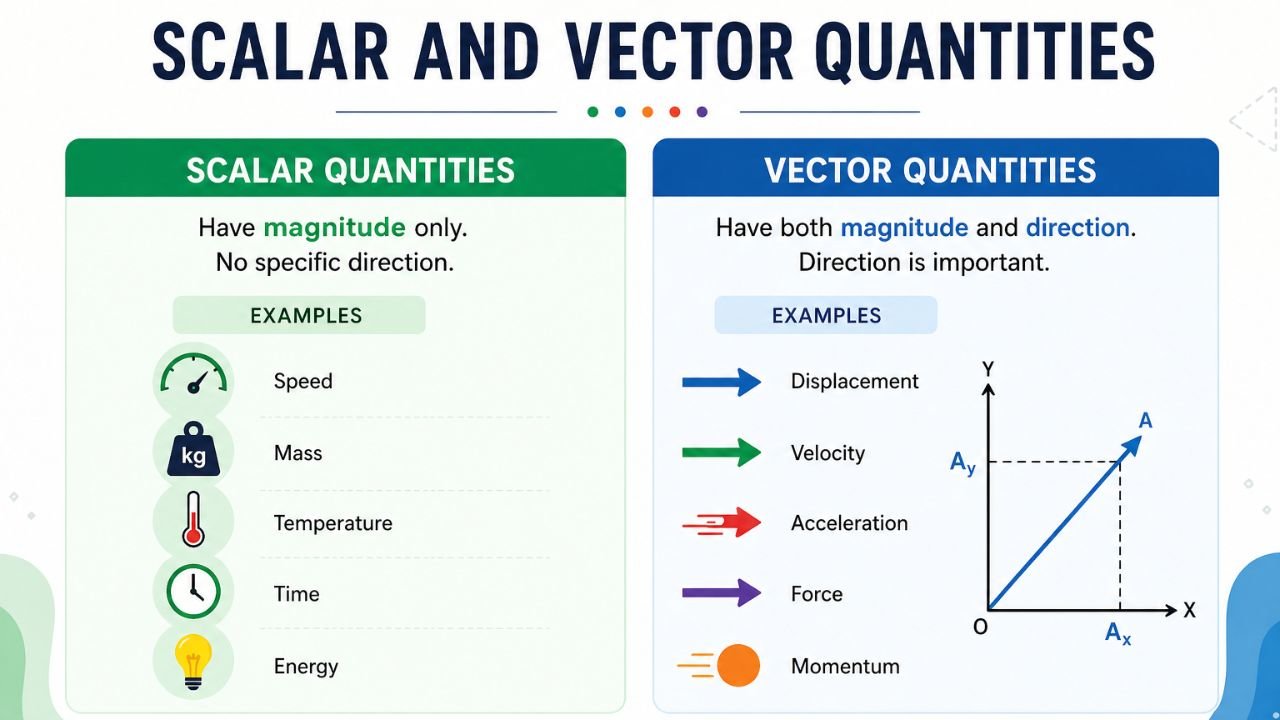
A scalar quantity is a physical quantity that possesses only magnitude, and there is no need to specify any direction to define it. Some examples of such quantities include mass, distance, speed, time, and temperature.
If it is said that a bike is moving at a speed of 50 km/h, the statement conveys how fast the vehicle is moving. But there is no direction of movement specified in it. Thus, scalars are represented by single numerical values along with their associated units.
What is a Vector Quantity?
A vector quantity is a type of physical quantity that also includes direction, along with its magnitude, in its specification. So it is more complex than a scalar quantity. Some examples of such quantities include displacement, velocity, acceleration, momentum, and force.
In other words, we can say that a vector quantity conveys not only “how much” of something but also “in which direction”. So, if you say that a truck is moving at 75 km/h towards the east, you are describing a vector quantity. That’s because you are specifying direction along with the magnitude of the quantity.
Difference Between Scalar and Vector Quantity
To be able to perform correct calculations with quantities, you need to be aware of the differences between scalars and vectors. Calculations on scalar quantities are performed with the use of simple arithmetic rules.
You can add these quantities, subtract them, multiply them, and divide them, just like ordinary numbers. For instance, if you drive 15 kilometers and then 10 kilometers more, the total distance covered by you is simply 25 kilometers.
On the other hand, in the case of vectors, careful handling is required for making calculations. It is not always possible for you to perform addition on them with the use of simple arithmetic because of the directions specified for them. You will have to use graphical methods or component-wise calculations.
For example, if 2 forces are acting on an object from different directions, the resultant of those forces will depend not only on the magnitude of the forces but also on the directions in which they act.
There is another significant difference in scalar and vector quantities, which is the way they are represented. You can represent a scalar by a simple symbol, such as “t” for time and “m” for mass. Vectors, on the other hand, are often denoted with arrows above their symbols or by making the letter bold (for instance, v for velocity).
In a graphical representation, you can represent vectors by arrows, where the magnitude of a quantity is indicated by the length of the arrow and the direction is indicated by the arrowhead.
Final Words
Both scalar and vector quantities collectively form the backbone of physical science. Scalars are simple as they have magnitude only, while vectors offer depth by indicating directions as well. With the use of both of these types of physical quantities, we can easily describe the physical world and make analysis with precision and clarity.
[Also Read: Difference Between Distance and Displacement: A Complete Guide]