

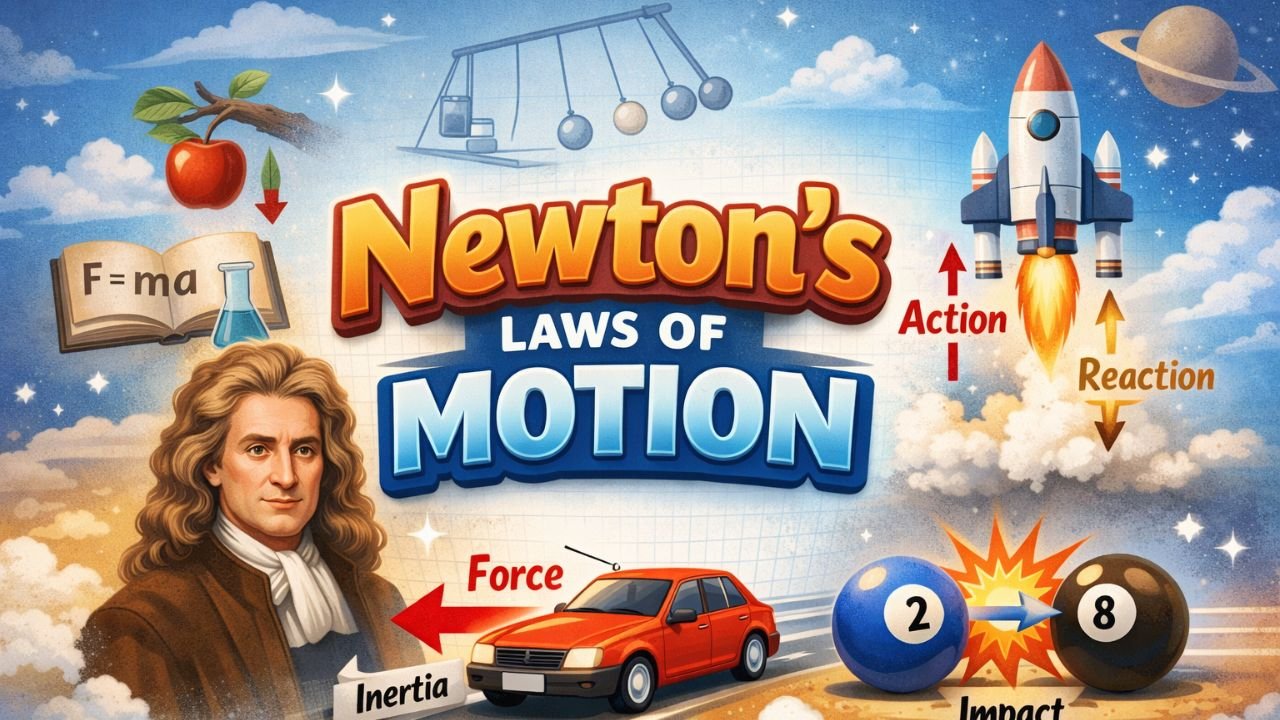

Fundamentals of physics also involve the understanding of how objects move. And, Newton’s Laws of Motion by Sir Isaac Newton work as the foundational laws for this understanding.
These laws relate the motion of objects and the forces acting upon them. The 3 laws were introduced in the 17th century, but they still remain essential for the study of engineering, mechanics, and physical phenomena of our everyday lives.
Introduction to Newton’s Laws of Motion
Classical mechanics, which is one of the main branches of physics, is based on Newton’s Laws of Motion. Mechanics deals with objects in motion under the influence of forces acting upon them. And, these laws by Sir Isaac Newton help you understand everything from the movement of a vehicle like a car to even the flight of a rocket.
Before we proceed to understand these 3 laws, it is crucial to understand the following two terms:
- Force: It is a pull or push acting upon an object
- Mass: It is the total amount of matter possessed in an object
Let’s now understand each one of the three laws one by one.
First Law of Motion: Law of Inertia
Newton’s First Law states:
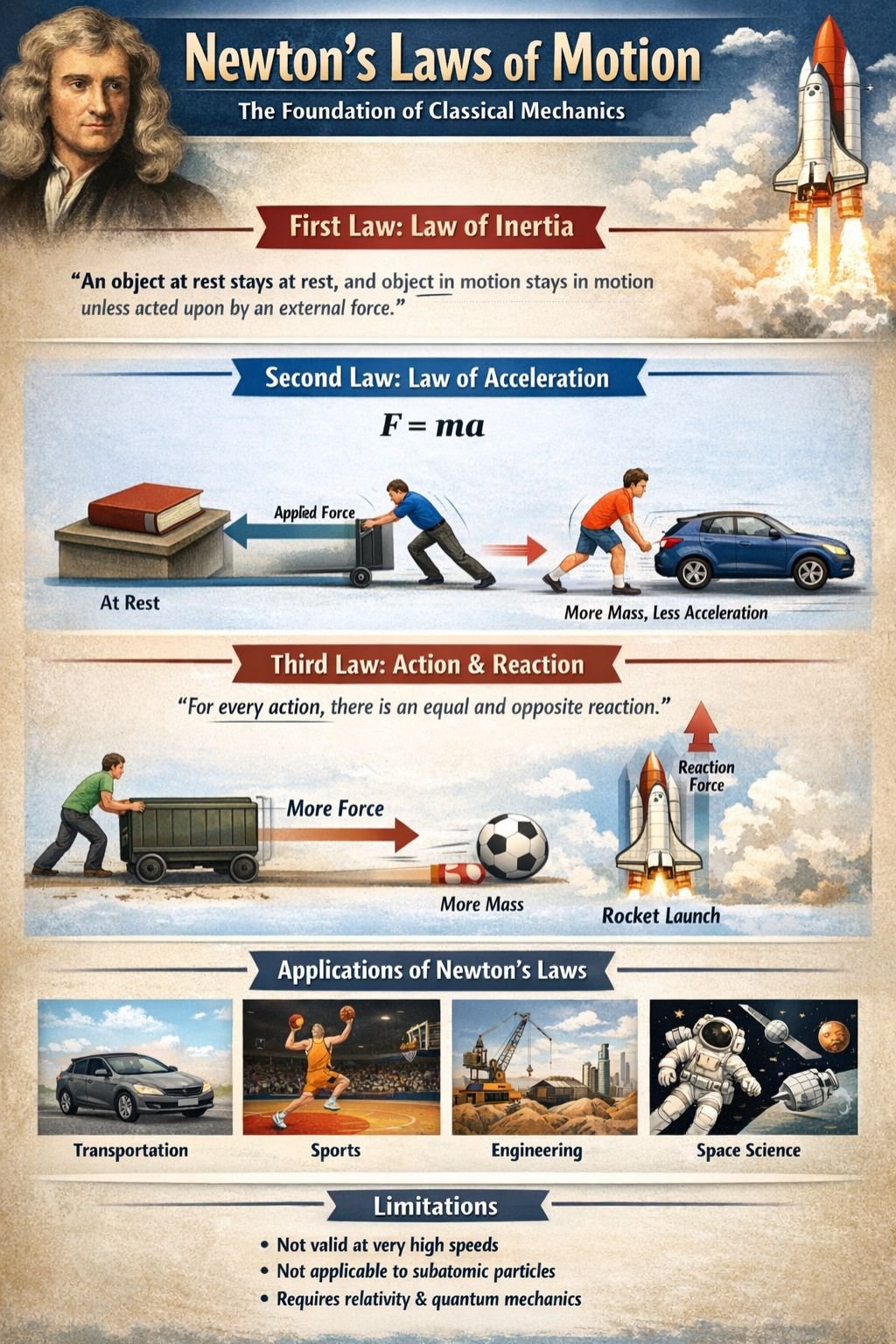
“An object, if it’s at rest, will stay at rest and, if it’s in motion, will stay in motion at a constant velocity, unless it is acted upon by an external force.”
The tendency of an object to resist changes in its state of motion is referred to as inertia. Hence, the first law of motion introduced the concept of inertia. The greater the mass of the object, the greater the inertia caused.
Some Real-Life Examples:
- If a book is lying on a table, it will not move unless it’s pushed or pulled by someone.
- If you are sitting in a moving car, you will lean forward if the car stops suddenly.
- A ball rolling on the ground will eventually be stopped due to friction (which is an external force)
Importance:
As this law indicates that your body will continue moving forward when your car suddenly stops, you understand the need for having a seatbelt while driving. If you have a seatbelt, you will be stopped by the belt from moving when the car stops.
Second Law of Motion: Law of Acceleration
Newton’s Second Law states:
“The rate of change in momentum of an object is directly proportional to the force applied on it, and the change occurs in the direction of that force.”
And, simply, we can write it as:
F = ma
Where:
- F represents the applied Force
- m represents the Mass of the object
- a represents Acceleration
So if the force increases, acceleration increases too, and if the force decreases, acceleration also decreases. This law explains how motion is affected by force.
Some Real-Life Examples:
- If you try to push or pull a cart, a heavier cart will need more force to accelerate than a lighter one.
- If a footballer kicks the ball harder, it will cause the ball to move faster.
- You will need less force to move a bicycle than a truck if the same acceleration is required in both cases.
Importance:
This law helps engineers in designing machines and vehicles. It is also used to calculate forces in manufacturing and construction.
Third Law of Motion: Action and Reaction
Newton’s Third Law states:
“For every action, there is an equal reaction in the opposite direction.”
In simple words, we can say that if an object exerts a force on another object, the other object also exerts a force of equal magnitude but in the opposite direction.
This indicates that forces always exist in pairs. Both forces of a pair are equal and opposite, and they act on different objects.
Some Real-Life Examples:
- While walking, your foot pushes the ground backward, and in response to the force exerted by your foot, the ground pushes you forward.
- In swimming, a swimmer pushes water backward, and the water helps the swimmer to move forward by applying the equal and opposite force in response.
- When a rocket is launched, gases are expelled downward, which, in response, pushes the rocket upward.
Importance:
By understanding this law, it becomes easy for you to understand propulsion systems such as jet engines, rockets, etc.
Applications of Newton’s Laws of Motion
These 3 laws of motion are not concepts that are just read in theory for a better understanding. They are, in fact, being applied in various aspects of our lives and in various industries as well.
- Engineers apply these laws to design safe and efficient machines and structures.
- Athletes apply these laws to improve their performances. For example, the laws help them understand how much force needs to be applied to hit the ball.
- Even in the transportation industry, these laws are reliable. That’s because they can explain how a vehicle starts, stops, and changes its direction.
- Space science is another field where Newton’s laws, specifically the 3rd law, are being applied.
Limitations of Newton’s Laws
Despite being so useful in our daily lives, Newton’s laws also have some limitations:
- These laws are not applicable in the case of atomic and subatomic particles. You will need to apply advanced theories in such cases, such as quantum mechanics, etc.
- If the speed of the object under consideration is extremely high, these laws don’t apply accurately.
Conclusion
From walking to driving to complex systems, including spacecraft, etc, Newton’s Laws of Motion provide a robust framework to help us understand how objects move and interact with one another. The laws are quite simple and easy to understand, but playing a critical role in explaining the physical world we are surrounded by.
Whether you are a student, scientist, or engineer, you will need to master these laws to conduct a proper analysis of motion and predict its outcomes. This analysis and prediction are essential for designing efficient systems.