Manufacturing is the backbone of the global industry. Whether it’s a smartphone, a car engine, a pharmaceutical product, or a simple household tool, every item around us is the result of a carefully designed manufacturing process.
Over the past few decades, manufacturing has transformed dramatically—shifting from labor-heavy methods to advanced automation, data-driven production, and highly optimized supply chains.
This comprehensive manufacturing guide is designed to help students, entrepreneurs, engineers, and business owners understand the essential elements of modern manufacturing.
From concept development and production planning to quality control and sustainable practices, this guide walks you through every important step.
Table of Contents
Understanding Manufacturing: What It Really Means
Manufacturing is the systematic process of transforming raw materials or components into finished goods. It involves people, machinery, workflows, and technology integrated into a structured production environment.
The primary goals of manufacturing include:
- Producing cost-effective, high-quality products
- Meeting customer and market demands
- Ensuring safety, compliance, and efficiency
- Reducing waste and optimizing resource use
- Maintaining consistent production output
Manufacturing can be as simple as assembling basic parts or as advanced as programming robots to perform nanometer-precision operations.
Types of Manufacturing Processes
Modern manufacturing involves a wide variety of processes. Understanding these is essential for determining the right method for your product.

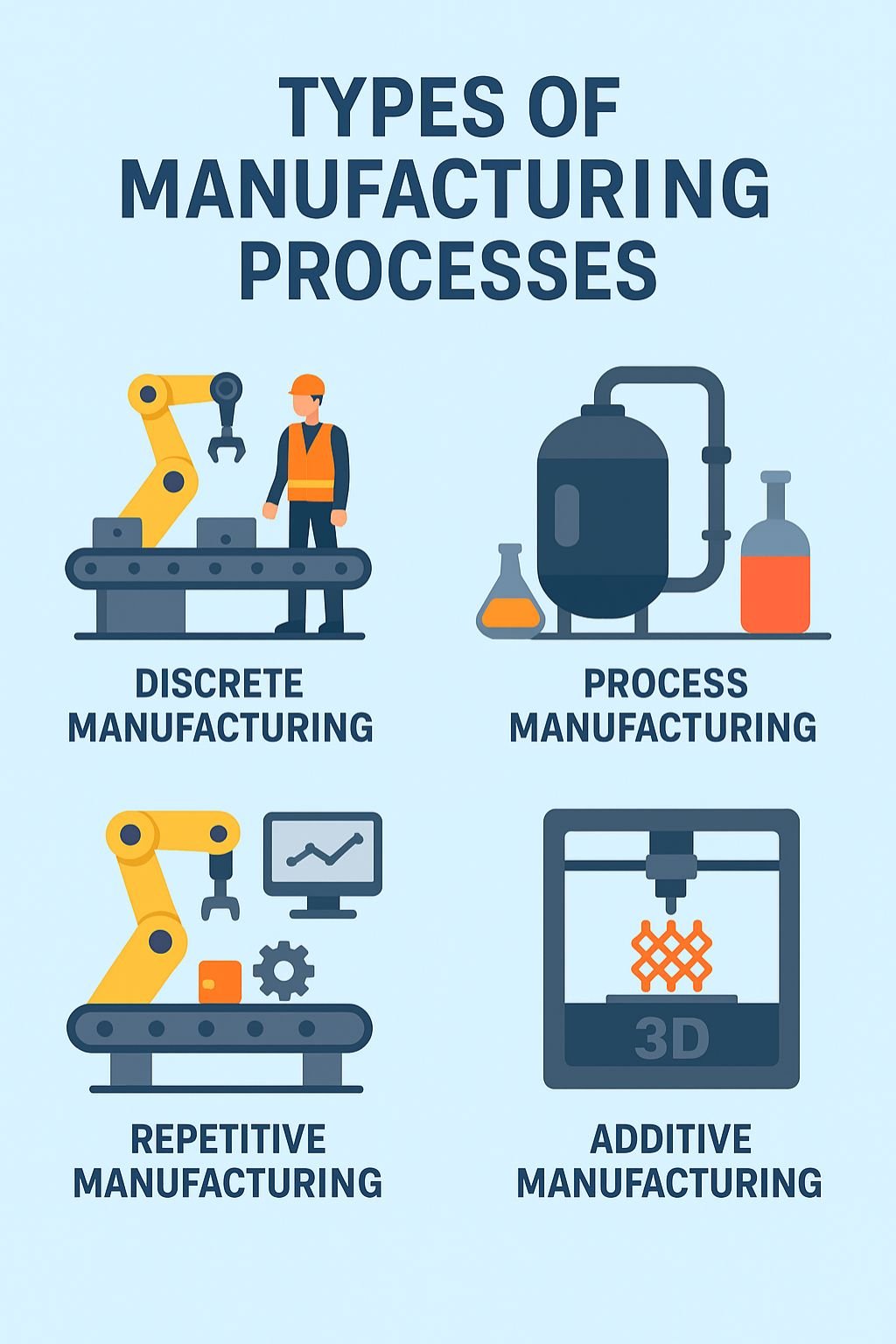
1) Discrete Manufacturing
Used when products are made from individual, countable parts—e.g.:
- Automobiles
- Electronics
- Furniture
- Appliances
Products can be easily disassembled, and production runs may vary.
2) Process Manufacturing
Used for products that cannot be physically separated into components. Examples include:
- Chemicals
- Food and beverages
- Paints
- Pharmaceuticals
Process manufacturing often requires batch control and strict quality monitoring.
3) Repetitive Manufacturing
Large-scale, continuous production of the same product:
- Bottled beverages
- Consumer electronics
- Packaged food
It enables economies of scale and reduces per-unit cost.
4) Job Shop Manufacturing
Customized, small-batch production with high flexibility:
- Prototyping
- Custom furniture
- Specialized machinery parts
Ideal for unique products rather than mass production.
5) Additive Manufacturing (3D Printing)
A modern method where products are built layer by layer using:
- Plastics
- Metals
- Resins
This is ideal for complex geometries, low-volume production, and rapid prototyping.
6) Continuous Flow Manufacturing
Used in industries where products must be produced without interruption, such as:
- Oil refining
- Gas processing
- Large-scale chemical production
The process is highly automated and must run continuously to be cost-effective.
Key Stages of the Manufacturing Cycle
To understand manufacturing deeply, it’s essential to break down the stages from concept to final product.
1) Product Concept & Design
The first step involves:
- Understanding customer needs
- Creating preliminary sketches
- Developing 3D models
- Running simulations
Design determines functionality, cost, and manufacturability.
2) Material Selection
Choosing appropriate materials affects:
- Strength
- Durability
- Weight
- Cost
- Environmental impact
Material choices include metals, polymers, ceramics, composites, and more.
[PS: It is crucial to analyze material properties like tensile strength, hardness, toughness, malleability, and ductility to ensure they match product requirements.]
3) Process Planning
A detailed manufacturing roadmap includes:
- Required machinery
- Production workflow
- Workforce allocation
- Time and cost estimations
- Safety protocols
The goal is to define the most efficient way to produce the product.
4) Prototyping
A prototype allows manufacturers to:
- Test functionality
- Identify design flaws
- Validate user experience
Prototypes can be physical or virtual, depending on the complexity.
5) Manufacturing Execution
This stage involves actual production by using:
- Machines
- Tools
- Labor
- Automation systems
Efficiency and accuracy are crucial at this stage.
6) Quality Control & Testing
Quality assurance ensures products meet specifications through:
- Inspection
- Testing
- Statistical analysis
- Compliance verification
Poor quality can lead to returns, warranty claims, and reputational loss.
[PS: Testing methods such as tensile tests and impact tests help ensure the quality and durability of materials and final products.]
7) Packaging & Distribution
Finally, products are packaged to ensure:
- Safety
- Shelf appeal
- Compliance with regulatory standards
Then they move through logistics to reach customers.
Essential Manufacturing Tools & Technologies
Manufacturing has become technology-driven. Below are the most important tools in modern production environments.

1) CAD & CAM Software
Computer-Aided Design (CAD) and Computer-Aided Manufacturing (CAM) are used for:
- Creating digital designs
- Precision machining
- Workflow automation
Tools include AutoCAD, SolidWorks, and Fusion 360.
2) CNC Machines
Computer Numerical Control machines automate cutting, drilling, and shaping tasks, offering:
- Precision
- Consistency
- Speed
Useful for metalworking and high-accuracy jobs.
3) Robotics & Automation
Robots perform tasks like:
- Assembly
- Welding
- Packaging
- Inspection
Robotics improves accuracy and reduces labor costs.
4) IoT & Smart Manufacturing
Sensors and connected systems enable:
- Real-time monitoring
- Predictive maintenance
- Automated quality analysis
Often part of Industry 4.0 environments.
5) 3D Printing
Used for:
- Rapid prototyping
- Custom components
- Simulation models
Reduces time-to-market significantly.
6) ERP & MES Systems
Enterprise Resource Planning (ERP) and Manufacturing Execution Systems (MES) help in:
- Production scheduling
- Inventory management
- Workflow tracking
- Compliance reporting
Centralized data leads to better decision-making.
Workforce and Skills Needed in Manufacturing
A successful manufacturing operation demands a skilled workforce with both technical and managerial capabilities.
1) Technical Skills
Workers need knowledge in:
- Machine operations
- Welding and fabrication
- Electric and mechanical repair
- Reading engineering drawings
- Robotics handling
Modern manufacturing requires multi-skilled operators.
2) Soft Skills
Important attributes include:
- Problem-solving
- Attention to detail
- Collaboration
- Analytical thinking
These skills help manage complex production tasks.
3) Training & Upskilling
With the rise of automation, continuous learning is crucial for:
- Robotics handling
- Data analytics
- Programming CNC machines
- Quality assurance systems
Companies that invest in training see improved productivity and reduced downtime.
Cost Factors in Manufacturing
Understanding cost is vital for profitability.
1) Raw Material Costs
Prices vary based on:
- Supplier location
- Market fluctuations
- Quality grades
Choosing the right supplier can save significant money.
2) Labor Costs
Includes:
- Wages
- Training
- Safety compliance
Automation can optimize labor distribution.
3) Machinery & Maintenance
Facility expenses include:
- Equipment installation
- Repairs
- Upgrades
Predictive maintenance reduces sudden breakdowns.
4) Overheads
General expenses include:
- Electricity
- Water
- Rent
- Security
- Insurance
Optimizing processes reduces overhead significantly.
Quality Control in Manufacturing
Quality control is not optional; it is essential.
– Types of Quality Control
- Incoming inspection: raw materials
- In-process inspection: ongoing production
- Final inspection: ready products
– Common Techniques
- Statistical Process Control (SPC)
- Six Sigma
- Lean manufacturing
- Total Quality Management (TQM)
– Industry Certifications
Depending on the product:
- ISO 9001
- ISO 14001
- GMP (Good Manufacturing Practices)
- CE marking
Certifications build customer trust.
Sustainability in Manufacturing
Sustainability has become central to modern production.
– Green Manufacturing Practices
- Using renewable energy
- Recycling waste
- Water conservation
- Energy-efficient machinery
– Circular Economy
Designing products so that components can be reused or repurposed.
– Eco-friendly Materials
Adopting biodegradable, recyclable, or low-impact materials is becoming a major trend.
Manufacturers investing in sustainability often experience:
- Lower operational costs
- Stronger brand reputation
- Better compliance
Future Trends in Manufacturing
Manufacturing is evolving rapidly with emerging technologies.
1) Industry 4.0
Smart factories using:
- IoT
- AI
- Big data
Allowing precise control over every process.
2) Autonomous Manufacturing
Self-regulating systems that adjust production without human intervention.
3) Artificial Intelligence Integration
AI helps in:
- Predictive maintenance
- Quality anomaly detection
- Inventory forecasting
- Production scheduling
4) Collaborative Robots (Cobots)
Robots designed to work alongside humans safely.
5) Advanced Materials
New materials like:
- Graphene
- Carbon-fiber composites
- High-entropy alloys
Enable stronger and lighter products.
Conclusion
Manufacturing is more than just producing goods—it’s a sophisticated system involving strategy, planning, technology, and skilled labor. As industries evolve, companies that embrace automation, digital transformation, and sustainability will lead the future of production.
Whether you’re starting a new manufacturing business, optimizing an existing operation, or simply learning the fundamentals, understanding the principles outlined in this guide will help you make informed decisions and stay competitive in a rapidly evolving world.